9 Nonverbal Communication Skills Every Presenter Needs
You said all the right things. You had the bulletproof slide deck. The market data. The 14-step plan. You even practiced in the mirror like a corporate Beyoncé.
And yet… something was off.
The client didn’t bite. Your boss looked unconvinced. Your team gave you nothing but nods and Slack silence.
Because while your mouth was saying “We’re confident in our direction”, your arms were crossed, your shoulders were hunched, and your tone said “I’m being held hostage by my own bullet points.”
That’s the thing about nonverbal communication. It never waits for your permission.
Whether you’re pitching to the C-suite, presenting to your team, or trying to look like you aren’t sweating through your shirt in a Teams meeting…
Your body is speaking. Loudly. Constantly. And sometimes? In the complete wrong language.
What Is Nonverbal Communication?
Nonverbal communication is more than just “body language.” It’s every silent signal you send (before, during, and after you speak).
The stuff your audience feels, even if you never say it out loud.
There are three main channels your nonverbal cues run through:
Body language - everything from gestures to posture to facial expressions to stance to movement
Vocal – tone, pitch, pace, pauses (aka the soundtrack behind your words)
Spatial (proxemics) – how you use space, where you stand, and how you move in a room
Nonverbal communication works even when you’re not, which is why it can either elevate your message… or quietly sabotage it.
Why Is Nonverbal Communication Important?
Nonverbal communication is important because it:
Shapes first impressions within seconds
Builds (or breaks) trust — fast
Hits the brain before your words do — people feel your energy before they process your message
Overrides your words — people believe what they see over what they hear
Decides engagement — nonverbal cues help your audience figure out: do I listen, tune out, or trust this?
Even if your content is gold, if your nonverbal signals don’t match, you lose people. Fast.
Now let’s unpack that further…
We judge fast.
In under 7 seconds, your audience decides if you’re worth listening to.
Before you even speak, they’ve already made a snap judgment about your credibility — based on nonverbal cues like your posture, your expression, and yes, even your outfit.
And what exactly are they assessing?
Five things:
Character
Competency
Trustworthiness
Sincerity
Authority
All of that?
Being scanned, sorted, and silently judged before you open your mouth. Your body walks into the room before your words do. So make sure it’s saying something worth listening to.
Trust is visual.
People believe what they see. If your tone, face, and gestures don’t back up your message? That tiny disconnect? It creates doubt.
Your delivery is the message.
Especially when you’re pitching, persuading, or leading a room — your nonverbals are the difference between “meh” and “memorable.”
You want your message to land? Your body has to cosign it.
What Percentage of Communication Is Nonverbal?
You’ve probably heard some version of this stat thrown around:
“93% of communication is nonverbal.”
And while that number gets a little oversimplified (because yes, your actual words still matter, don’t panic), research does show that a huge chunk of how we interpret meaning comes from tone, facial expressions, gestures, and body language.
Here’s the breakdown from psychologist Albert Mehrabian’s famous study:
7% = words
38% = tone of voice
55% = body language
So if you’re laser-focused on your script but ignoring how you say it or how your body backs it up? You’re putting 93% of your impact on mute.
Your audience isn’t just listening. They’re watching. They’re feeling. They’re decoding your every move like a Netflix detective show.
And Mehrabian’s not alone.
Decades of studies across psychology, neuroscience, and communication research have all confirmed it: At a minimum, 50% of what we communicate is nonverbal.
That means even on your best day with your best slide deck… your body might still be the loudest thing in the room.
9 Nonverbal Communication Skills
You don’t need to say anything to communicate something.
You already are.
Here are 9 ways you’re communicating with your audience nonverbally.
1. Facial Expressions
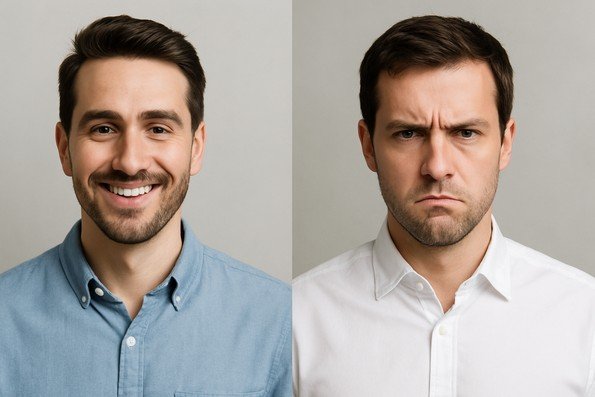
Your face is your homepage. It’s the first thing people look at, and the last thing they remember.
And guess what? It’s broadcasting everything, even the stuff you wish it wouldn’t.
You might be saying, “That’s a great question,” but if your eyebrows are on a rage hike and your lips are pressed into a tight little line?
You just silently communicated: “That’s a terrible question and I hate that you asked it.”
Welcome to the wild world of microexpressions… those lightning-fast flashes of emotion that slip out before your brain can spin them into something polite.
They’re universal, hardwired, and nearly impossible to fake. (We’re talking nanoseconds of “did you just roll your eyes?” territory.)
Here’s where it gets tricky: Most of us have resting faces that send unintentional messages.
Resting disapproval face
Resting confusion face
Resting existential dread face
These expressions aren’t wrong. They’re just unfiltered. And when you’re presenting? They matter. Because your audience doesn’t just hear your words, they read your face for emotional context.
Are you excited? Anxious? Annoyed? Checked out?
If your facial expression doesn’t match your message, your audience feels the disconnect. Even if they can’t name it, they’ll notice it.
One of my clients (portfolio manager) ran into this exact issue.
He had a resting “focused face” that came across as… well, menacing. Angry, even. All because he unconsciously scrunched his eyebrows together whenever he concentrated.
I clocked it immediately as focus. But to a client across the table? It could read as “I hate this and I’m about to cancel your account.”
He’d never realized it until he recorded himself speaking (which I always have my clients do). Watching the footage back, he saw it clearly… and laughed out loud.
I asked, “Have you ever considered telling clients up front that your eyebrows get intense when you’re thinking hard?”
He paused, then said, “I’ve never even thought of that. But yeah… I’m going to start saying it.”
A two-second reframe that built instant clarity and trust.
So: film yourself. Seriously. Talk through a section of your next presentation, mute the sound, and just watch your face.
Are you as engaged as you think you are?
If not, practice with intention. Raise your eyebrows (just a little), soften your jaw, bring some warmth into your eyes, and smile.
2. Gestures
Gestures are the body’s exclamation points.
They punctuate your message. They give shape to your ideas. And when they’re aligned with your words? They help your audience see what you mean.
When used well, gestures can:
Emphasize key points
Help your audience follow your structure (think: counting on fingers, motioning left to right)
Signal confidence and clarity
When misused or overdone? You can look frantic, insincere, or just plain distracting.
That’s gesture overload. It’s giving interpretive dance when we just needed “strategic update.”
Why Your Hand Gestures Matter Most

Hannah Michelotti presenting on stage, using expressive hand gestures to demonstrate the power of non-verbal communication during a talk.
Your hands are your most visible (and most psychologically powerful) tool for nonverbal communication.
Why?
Because humans are hardwired to look at hands first to assess safety.
In the caveman days, hands holding a spear meant run.
Hands offering an apple pie? Much more welcoming.
That same instinct lives on in boardrooms and Zoom calls.
If your hands are:
Hidden (in pockets, under the table, behind your back) → subconsciously signals threat or discomfort
Stiff or awkward → suggests nervousness or lack of conviction
Flying everywhere → chaotic energy, distraction central
But if your hands are:
Open and visible
Used with intention to match and support your message
Anchored in gesture “zones” (roughly waist to chest height)
You immediately appear more confident, trustworthy, and clear.
So no, it’s not just “what to do with your hands.” It’s how your audience decides whether to believe you.
3. Paralinguistics (tone, pitch, volume)
You can say the exact same sentence ten different ways and mean something wildly different each time.
That’s paralinguistics.
It’s the how behind your what. Your tone. Your pitch. Your pace. Your pauses.
It’s the vocal soundtrack that tells your audience whether to believe, ignore, or straight-up side-eye your message.
You can be saying: “I’m really excited about this project.”
But if your voice sounds like you’re narrating a slow-motion funeral montage, then guess what? Your audience is going to believe your delivery, not your words.
The Monotone Menace
Most people don’t even realize when they slip into monotone.
It’s like vocal autopilot, the verbal version of reading a terms and conditions page out loud.
But it’s brutal for engagement. A flat tone says: “I don’t care.” Even if you do.
So if you’re wondering why your big idea landed with the energy of a soggy rice cake?
Start by checking your tone.
And yes, record yourself.
In a recent session, three of my portfolio managers said the same thing after watching back their client call footage: “I had no idea I sounded so monotone.”
Until they heard it, they didn’t believe it. But once they did? Game changer.
Quick Fixes To Improve Your Voice and Tone When Speaking:
Pause for effect — especially before key points
Smile while you speak (yes, even virtually) — it literally warms your tone
Vary your pitch and pacing — like a good storyteller, not a GPS robot
Record yourself and listen back — cringe now, sound magnetic later
Paralinguistics is one of the fastest ways to upgrade your communication, because even small tweaks can make you instantly more compelling.
4. Posture & Movement
Your posture tells the room how seriously to take you, before you say a single word.
Slouched over? Arms crossed? One hip cocked like you’re waiting in line at CVS?
You might feel confident, but that’s not what your body’s saying.
Posture is presence. It’s how you claim space without words. And when it’s off, your credibility takes a hit, even if your content’s airtight.
Stand (or sit) with a strong spine, relaxed shoulders, feet grounded. You want to look like you believe in what you’re saying, because if you don’t, why should your audience?
Movement matters too.
Are you swaying? Pacing like you’re trying to close your Apple Watch rings? All of that reads as nervous energy. Instead, keep your movements purposeful.
A step forward to emphasize a key point.
A pause to let something land. Stillness when you want full attention.
Commanding presence doesn’t come from doing more. It comes from intentionality. When your posture and movement match your message, people lean in.
When they don’t? They check out.
5. Eye Contact
You know when someone holds eye contact for a beat too long, and you start wondering if you owe them money?
Yeah, don’t be that person.
Eye contact is supposed to connect, not creep.
Most people either avoid it entirely and stare at the back wall like it’s got answers, or, lock eyes like they’re trying to extract a confession
Neither works.
Here’s what I tell my clients: Look just above the eyes, at the bridge of the nose or between the eyebrows.
It feels like eye contact, but without the awkward intensity.
Aim for a few seconds, then shift. Bounce around the room..
And if you’re on Zoom, look at the camera when it counts. Yes, it feels weird — because your brain wants to look at the most familiar thing on screen: your own face.
But resist the urge.
Looking directly into the lens simulates real eye contact for the person on the other side. It doesn’t just feel more engaging, it is.
6. Proxemics (use of space)
Proxemics is just a fancy word for how you use space when you speak, and most people don’t realize how much it affects the room (or the Zoom).
If you hover near a wall or stay glued to the side of the stage, you’re sending the message: “I don’t fully believe what I’m saying.”
But when you step forward with purpose?
When you plant your feet and claim the center of the space?
That tells your audience: “This matters. I mean it.”
Even on video calls, spatial cues count.
Are you:
Sitting up, centered in frame, close enough to be seen?
Or hunched off to one side, looking like you fell into the call by accident?
Confidence takes up space. Nervousness tries to disappear.
7. Haptics (touch & physical interaction)
Touch communicates. A lot.
A handshake. A pat on the back. A fist pump.
These small interactions can say:
“I’ve got you.” “I see you.” “This is a moment.”
But haptics is a minefield.
What feels encouraging to one person can feel awkward, invasive, or even threatening to someone else. And this isn’t just about personality. It’s about culture, context, and very often, gender.
Touch in the workplace ( especially men interacting with women) requires an extra layer of awareness. Power dynamics matter. So do past experiences, cultural expectations, and yes, physical space.
Quick example:
I once had a handshake that felt like a bear trap.
Bruised shoulder. I wish I were joking.
And then there was the time a male colleague smacked a female coworker on the ass as she walked past his desk.
He ended up in HR’s office faster than you can spell “fired.”
He was let go that day. Oof.
My point? If you’re unsure, don’t touch. Let your words and energy do the heavy lifting.
8. Appearance & Attire
ALT TEXT: Man presenting on stage in business-casual attire, demonstrating how appearance and non-verbal communication impact audience perception.
This isn’t about being “fashionable.” It’s about being intentional.
Your appearance is one of the first nonverbal signals your audience receives. Before you speak, before you click to slide two, they’ve already made a judgment.
Are you signaling confidence or uncertainty?
Authority in a sharp blazer, or “I just rolled out of bed and don’t care” in wrinkled linen?
Intentional and put-together says. “Take me seriously.”
Thrown-together and chaotic says, “I barely made it here.”
You don’t need to win best dressed. But you do need to look like you thought about it.
Ask yourself:
Does what I’m wearing match the tone of what I’m saying?
Am I dressed in a way that supports credibility, not distracts from it?
Would I take myself seriously walking into this room?
This goes for Zoom, too.
If your audience is looking up your nose from your couch pillow pile while you rock a hoodie with mysterious soup stains… they’re not listening to your insights. They’re wondering if you’re okay.
Your clothes, your grooming, your background — they’re all part of your message.
So make sure they’re on message.

9. Artifacts
No, not Indiana Jones artifacts.
We’re talking about the objects you bring into the room (physically or virtually) that quietly shape how people perceive you.
Yes, that includes:
Your slides
Your notes
Your laptop stickers
Your branded coffee mug
But it also includes what you’re physically wearing, the visible choices that speak before you do.
Glasses
Your outfit
Visible tattoos
Hair clips or ties
Makeup and nail polish
Watches and smart tech
Earrings, bracelets, necklaces, rings
These are all artifacts.
And whether you meant to or not, you’re sending a message with every single one.
Are you signaling personality, polish, professionalism… or distracted chaos?
Some artifact checks worth making:
Does your outfit match the tone of the meeting? (Strategic pitch ≠ beach linen and Birks)
Are your jewelry or accessories subtle support or noisy distractions?
Are you rocking a Harvard pin, company swag, or a bold tattoo that might speak louder than you do? (Not bad — but be aware of what it says)
Are your glasses smudged?
Is your watch or fitness tracker lighting up mid-sentence and pulling focus?
Is your bag, briefcase, or purse clean and professional — or half-unzipped and stuffed with chaos?
Your artifacts are telling a story. Make sure it’s the one you meant to tell.
Common Nonverbal Communication Mistakes
Even the best speakers accidentally send mixed signals.
Here’s what that looks like in the wild, and how to catch yourself before your body tanks your message:
Mismatched messaging – Saying “I’m excited to be here” while your body’s curled up like a croissant? You’re not convincing anyone. (Film yourself. You’ll see it.)
Inconsistent facial expressions – Talking about the brilliant strategy behind your new launch… while frowning like you just bit into a lemon? That’s a no.
Monotone – Flat voice = flat energy. Most people don’t realize when they slip into it, but your audience feels it instantly.
Eye contact overload – Staring at people like a lighthouse beam scanning the coast. Instead: aim for 2–3 seconds, then move on.
Closed posture – Hunched shoulders, hands in pockets, movement that never leaves the “t-rex rectangle.” It reads as nervous or unsure.
Pacing and swaying – Constant motion = unsettled energy. You don’t need to be still, but you do need to be intentional.
The fidget trap – Clicking pens, fiddling with jewelry, tapping your fingers… it’s distracting. For everyone.
Zoom-specific mistakes – Camera up the nose. Bad lighting. Sitting too far back like you’re giving a TED Talk from another room. Fix your frame. We need to see your face, not your ceiling fan.
How to Improve Your Nonverbal Communication Skills
You don’t need to reinvent your personality. You just need to pay attention and make a few key shifts.
Here’s where to start:
Tip 1 – Manage stress in real-time
This one starts with posture.
When you sit or stand straighter, it literally lowers cortisol and increases confidence.
Yes, your body chemistry changes when you uncurl from that anxiety ball.
Straight spine. Shoulders back. Feet grounded. It works.
Tip 2 – Build emotional self-awareness
You can’t fix what you don’t feel.
Start noticing your microexpressions.
And I’m sure you know what I’m going to suggest… Film yourself. Again.
Watch for those microexpressions — the tiny flashes of discomfort, doubt, or disconnection that your audience feels, even if they can’t name them.
You can’t spot those subtle cues in the mirror. You need to see yourself in the wild. Under real lighting.
Tip 3 – Practice congruence (words + body = match)
If your message is “This is exciting,” your tone, gestures, and face need to show that.
When words and body don’t match, your audience gets confused, and confusion breaks trust. Keep them aligned.
Tip 4 – Learn to read other people’s nonverbal cues
Communication is a two-way mirror.
Start clocking posture, eye contact, pacing, tone shifts.
Your audience is telling you how they feel, even when they don’t say a word.
Tip 5 – Record & review yourself (yes, cringe and all)
Mute the audio. Watch your face, your hands, your posture.
Are you saying “I’m confident” while fidgeting like a squirrel in traffic?
You’ll catch things you never knew you were doing — and you will get better.
Tip 6 – Use controlled, purposeful gestures
Illustrative gestures are your best friend.
Count. Show size or direction. Emphasize key points. But make them clean, intentional, and above all, natural. No jazz hands. No air traffic control.
Tip 7 – Practice strategic eye contact
Not a stare. Not a scan. Think short hits (2 to 3 seconds) right between the eyebrows or at the bridge of the nose.
Say It Like You Mean It, And Look Like It Too
You’ve done the prep. You’ve got strong ideas, a solid message, and probably a few too many fonts in that slide deck. But if your body’s sending one signal and your voice is sending another, your message gets lost somewhere in between.
That’s where I come in.
If you want support with:
Aligning your nonverbal cues with your message (so nothing gets lost in translation)
Showing up with authentic confidence — not memorized bravado
Spotting what’s silently tanking your delivery… and change it fast
Communicating with clarity, charisma, and actual presence — on Zoom or in the room
Let’s do it.
Buy My Brain – A 60-minute power session to tweak, tighten, and level-up your delivery.
Train your whole team to present with confidence. This hands-on workshop helps your people align their voice, body, and message — so they win trust, close deals, and stop losing attention mid-slide.